
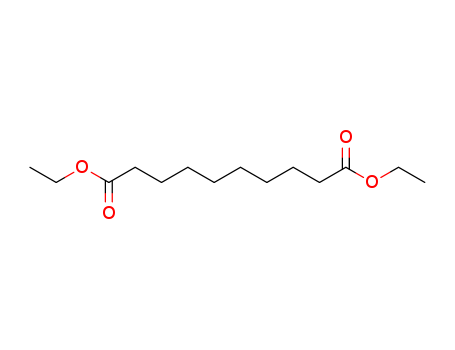
- Chemical Name Diethyl sebacate
- CAS No. 110-40-7
- Contact Us Inquiry
Diethyl sebacate Good Manufacturer supply High Quality 110-40-7
- Molecular Formula: C14H26O4
- Molecular Weight: 258.358
- Appearance/Colour: clear colourless liquid
- Vapor Pressure: 0.000544mmHg at 25°C
- Melting Point: 1-2 °C(lit.)
- Refractive Index: n20/D 1.436(lit.)
- Boiling Point: 312 °C at 760 mmHg
- Flash Point: 135 °C
- PSA: 52.60000
- Density: 0.969 g/cm3
- LogP: 3.23340
Diethyl sebacate(Cas 110-40-7) Usage
|
Application |
Dibutyl Sebacate (DBS) provides superior low temperature flexibility properties to a variety of polymers. The low temperature benefits of DBS make it an excellent choice for vinyl food contact films used in refrigeration. It provides excellent compatibility with a range of plastic materials including vinyls, acrylics, nitrile rubber, Buna-n rubber and some cellulosics. |
|
Content analysis |
It can be determinated by a non-polar column method in GT-10-4 or by the method I in the ester assay (OT-18). The amount of sample taken was 1 g. The equivalent factor (e) in the calculation is 64.59. |
|
Toxicity |
LD50 14470 mg/kg (rat, oral). |
|
Maximum level |
FEMA (mg/kg): soft drinks 4.1; cold drinks 9.1; candy 21; baked goods 41; pudding class 3.2 to 19. |
|
Production method |
It is derived by esterification of succinic anhydride and ethanol; It can also be obtained through heating esterification of sebacic acid and ethanol in the presence of concentrated sulfuric acid. |
|
Definition |
ChEBI: Diethyl decanedioate is a fatty acid ester. It is the diester of ethyl alcohol and Sebacic Acid that used as an aromatic in food. |
|
Preparation |
Diethyl sebacate is obtained by heating sebacic acid and ethanol in the presence of concentrated H2SO4 or other acid catalysts. |
|
General Description |
Diethyl sebacate is a volatile organic compoind used as a flavoring agent. It is reported to be found in longan honey porduced by Apis cerana. |
|
Health effects |
Diethyl sebacate is reported to be used in cosmetics at 1.5%, and no irritation or sensitization was reported in clinical studies of a formulation containing 1.5% diethyl sebacate. |
|
Flammability and Explosibility |
Notclassified |
|
Contact allergens |
This emulsifer has rarely been reported as a sensitiz- ing agent, mainly in topical treatments. |
|
Safety Profile |
Mildly toxic by ingestion. A skin irritant. See also ESTERS. When heated to decomposition it emits acrid smoke and irritating fumes. |
InChI:InChI=1/C14H26O4/c1-3-17-13(15)11-9-7-5-6-8-10-12-14(16)18-4-2/h3-12H2,1-2H3
110-40-7 Relevant articles
-
Diaper,D.G.M.,Mitchell,D.L.
, p. 319 - 327 (1965)
-
Synthesis and intrinsic blue fluorescence study of hyperbranched poly(ester-amide-ether)
Zhang, Yong,Fu, Qi,Shi, Wenfang
, p. 2452 - 2460 (2010)
A series of hyperbranched poly(ester-ami...
-
Diaper,D.G.M.,Mitchell,D.L.
, p. 1189 - 1195 (1962)
-
Biomass-derived dibasic acids to diesters with inorganic ligand-supported catalyst: synthesis, optimization, characterization
Chen, Zhe,Han, Sheng,Lu, Deli,Xu, Yumeng
, (2021/08/23)
Several attempts have been made to obtai...
The synthesis of di-carboxylate esters using continuous flow vortex fluidics
Britton, Joshua,Dalziel, Stuart B.,Raston, Colin L.
, p. 2193 - 2200 (2016/04/19)
A vortex fluidic device (VFD) is effecti...
METHOD FOR CONTINUOUSLY PREPARING CARBOXYLIC ACID ESTER
-
Paragraph 0030; 0034, (2013/11/19)
A method for continuously preparing a ca...
Influence of positional isomers on the macroscale and nanoscale architectures of aggregates of racemic hydroxyoctadecanoic acids in their molecular gel, dispersion, and solid states
Abraham, Shibu,Lan, Yaqi,Lam, Ricky S. H.,Grahame, Douglas A. S.,Kim, Jennifer Jae Hee,Weiss, Richard G.,Rogers, Michael A.
experimental part, p. 4955 - 4964 (2012/07/13)
Inter/intramolecular hydrogen bonding of...
110-40-7 Process route
-

-
42367-85-1
bis-(5-ethoxycarbonyl-valeryl)-peroxide

-

-
539-82-2
ethyl n-valerate

-

-
1968-40-7
ethyl 4-pentenoate
-
-
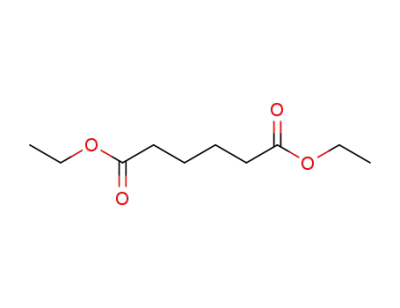
141-28-6
diethyl adipate
-

-
110-40-7
diethyl sebacate
| Conditions | Yield |
|---|---|
|
bei der explosiven Zersetzung;
|
-
-
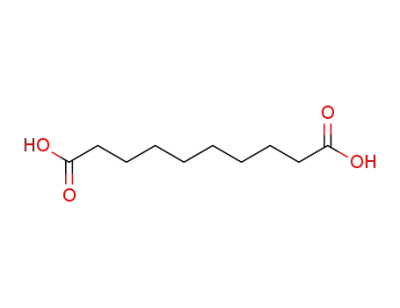
111-20-6,26776-29-4
1,10-decanedioic acid
-

-
64-17-5
ethanol
-
-
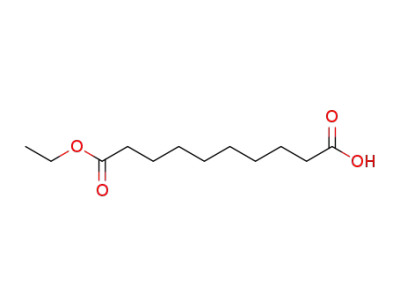
693-55-0
monoethyl sebacate
-
-
110-40-7
diethyl sebacate
| Conditions | Yield |
|---|---|
|
With
sulfuric acid;
In
cyclohexane; water;
for 24h;
|
37%
|
|
With
sulfuric acid;
|
110-40-7 Upstream products
-
111-20-6
1,10-decanedioic acid
-
64-17-5
ethanol
-
626-86-8
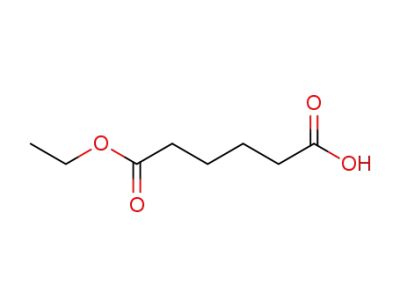
adipinic acid monoethyl ester
-
693-55-0
monoethyl sebacate
110-40-7 Downstream products
-
4629-03-2
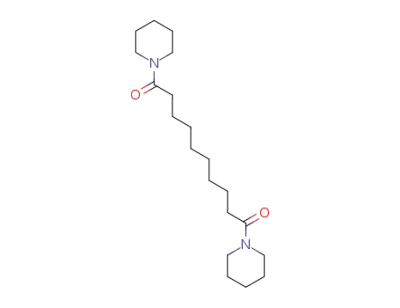
1,10-di(piperidin-1-yl)decane-1,10-dione
-
3350-30-9

cyclononanone
-
13747-10-9

cyclooctadecane-1,10-dione
-
22092-59-7

2,11-dimethyldodecane-2,11-diol